
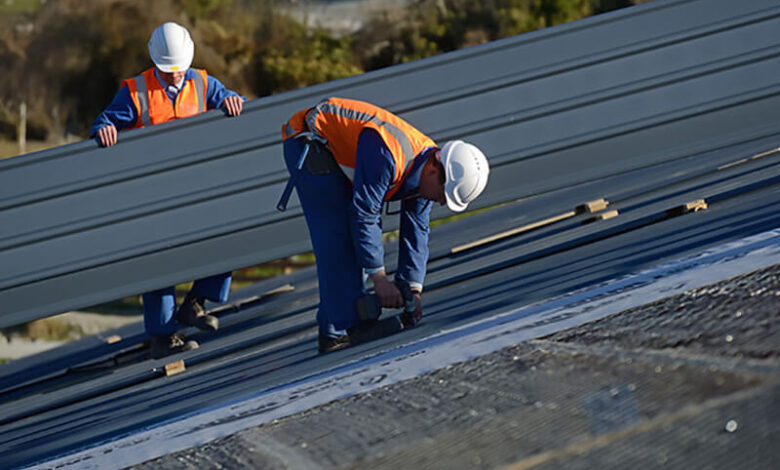
Industrial roofs don’t get the attention they deserve until water starts appearing somewhere it shouldn’t. By that point, the problem has usually been developing for months — through a compromised flashing, a cracked panel, a blocked outlet, or a failed sealant joint that was perfectly preventable with routine inspection.
For facility managers and building owners responsible for warehouses, manufacturing plants, distribution centres, and other large-format commercial properties, the roof is one of the highest-risk components in the building envelope.
Understanding what professional industrial roofing services involve, how repairs are prioritised and carried out, and why proactive maintenance consistently outperforms reactive repair is practical knowledge that every facility manager should have.
What makes industrial roofing different
Industrial roofs present a different set of challenges to commercial or residential roofing. The scale alone sets them apart — a large warehouse or manufacturing facility might have several thousand square metres of roof surface, potentially across multiple buildings or sections with different roof types, ages, and conditions.
Corrugated or trapezoidal metal sheeting (Colorbond or equivalent) is the most common cladding type on post-1980 industrial buildings in Perth. Older industrial buildings may have fibrous cement sheeting, which presents specific challenges around age-related brittleness and the regulatory requirements that apply to any asbestos-containing material in pre-1990 construction.
Roof penetrations — for HVAC equipment, exhaust systems, skylights, vents, and electrical conduit — are among the most common failure points on industrial roofs. In Perth’s climate, with its wide daily and seasonal temperature range, thermal movement is substantial, and its effects on flashing integrity accumulate over years.
Common industrial roof defects and their causes
A thorough industrial roofing repair programme starts with understanding the defects you’re most likely to encounter — and the mechanisms that produce them.
Fastener failure and corrosion is endemic in metal roofing of any age. As fasteners corrode, the seal between the fastener and the sheet degrades, creating a water entry point that is easy to miss from ground level but straightforward to identify on a close inspection.
Gutter and valley deterioration occurs as metal gutters corrode from the inside — driven by the accumulation of debris, standing water, and the organic acids produced by decomposing leaf matter. Box gutters on older industrial buildings are particularly prone to this.
Sheet lap and seam failure occurs where roofing sheets overlap or join. Water penetrating at sheet laps can travel considerable distances along the underside of the roof before dripping through — making the visible entry point inside the building an unreliable guide to where the fault actually is.
Skylight and translucent panel deterioration is common on industrial buildings with polycarbonate or fibreglass skylights. These materials yellow, craze, and become brittle with UV exposure, and their framing systems corrode and allow water ingress.
Membrane and waterproofing failure affects flat or low-pitch roof sections, which are common on building additions, plant rooms, and canopy structures. Membrane systems have finite service lives, and once they begin to fail, water ingress follows quickly.
The maintenance versus repair calculus
The economics of industrial roof maintenance versus emergency repair follow the same logic as most building maintenance: preventive investment consistently costs less than reactive remediation, and the differential grows with the scale of the building.
From a maintenance standpoint, industrial roofs benefit from at least an annual inspection — typically timed before the Perth winter rainfall season begins. An inspection carried out in late summer or early autumn will identify debris accumulation in gutters and valleys, any fastener or sealant issues that developed over summer, and any storm damage from the preceding year.
This timing allows any identified repairs to be scheduled and completed before the roof is put under maximum demand by winter rainfall — rather than being discovered when water is already entering the building.
What a professional industrial roofing service covers
A comprehensive industrial roofing services programme should include both the inspection and the remediation capacity to address what’s found.
Inspection covers all accessible roof surfaces, gutters, valleys, downpipes, penetrations, flashings, fasteners, skylights, and roof-level equipment platforms. It should produce a clear written report with photographs, a severity rating for any identified defects, and recommended remediation actions with priority ranking.
For larger industrial buildings with multiple roof sections of varying age and condition, a priority-based repair schedule is a practical approach: identify the highest-risk sections first, and work through lower-priority items systematically over subsequent maintenance cycles.
Working safely on industrial roofs
Safety is a non-negotiable consideration for any industrial roof work. Falls from height are among the most serious risks in building maintenance work, and industrial roofs — with their large surface areas, varying pitch, and often fragile elements like skylights and deteriorated sheet sections — present genuine hazards.
Professional industrial roofing contractors work in compliance with Western Australia’s work health and safety requirements for working at height, including risk assessment, fall protection systems, and appropriate equipment for the specific roof type and access conditions.
Industrial roofs are large, complex, and exposed to more cumulative stress than almost any other component of the building envelope. When they’re maintained regularly, they perform reliably for decades. When they’re not, the deterioration that accumulates quietly over dry Perth summers announces itself dramatically when the first winter rains arrive.
For facility managers and building owners, the message is straightforward: an annual inspection before winter, a structured approach to addressing identified defects, and a reliable trade partner with genuine industrial roofing experience are the three elements that distinguish well-managed industrial properties from those that face recurring, costly roof problems.


