
Walk through almost any Perth hardware store and you’ll find a wall of LED globes and fittings. The range is vast, the prices vary enormously, and the technical language on the packaging — lumens, colour temperature, CRI, beam angle, dimmability — can be genuinely confusing. It’s no surprise that many homeowners either pick up a handful of cheap replacements and hope for the best, or put the whole project in the too-hard basket and keep paying for inefficient lighting.
A residential LED lighting installation, done properly, is one of the smartest upgrades a Perth homeowner can make. It reduces electricity bills, eliminates the ongoing hassle of frequent globe replacements, and — when done thoughtfully — transforms the look and feel of interior spaces. This guide cuts through the confusion and gives you what you actually need to know.
The Real Benefits of Switching to LED at Home
If you’re still running halogen downlights — by far the most common situation in Perth homes built between the 1990s and 2010s — the energy savings from switching to LED are substantial. A standard 50W halogen downlight replaced by a 7–10W LED equivalent reduces the energy consumption of that fitting by 80–85%. In a home with 20 downlights, that’s a saving of approximately 800W of continuous load while the lights are on.
Run those 20 downlights for five hours per evening, and the halogen fittings consume 5 kWh per night. The LED replacements consume approximately 0.9 kWh. At Perth’s residential electricity rates (currently around 31 cents per kWh for the first tier), that’s a saving of roughly $1.27 per night, or over $460 per year — from 20 downlights alone.
Beyond energy costs:
- Halogen globes fail every 2,000–3,000 hours of operation. Quality LED replacements are rated for 25,000–50,000 hours — essentially the life of the fitting.
- Halogens generate substantial heat — relevant both for comfort and for fire risk in poorly ventilated ceiling spaces. LED fittings run cool, reducing the thermal load in ceiling cavities.
- LED lighting is compatible with smart home systems — Zigbee, Z-Wave, and WiFi-based smart globes and dimmers allow app and voice control, scene setting, and automated scheduling.
Understanding LED Lighting Specifications
The shift from watts to lumens as the measure of light output is the most important concept for homeowners navigating LED product selection.
Watts measure energy consumption, not brightness. Lumens measure actual light output. When replacing a 50W halogen downlight, you’re looking for an LED fitting that produces a similar lumen output — typically 450–600 lumens for a standard downlight application.
Other key specifications:
- Colour temperature (Kelvin) — warm white (2700–3000K) is the most comfortable for living areas and bedrooms, closely matching the halogen appearance. Cool white (4000K) works well in kitchens, bathrooms, and task areas. Daylight (5000–6500K) is typically reserved for garages, workshops, and utility spaces.
- Colour Rendering Index (CRI) — measures how accurately the light source renders colours compared to natural daylight. Look for CRI of 80+ for living spaces; 90+ for areas where colour accuracy matters (makeup, artwork, food preparation).
- Beam angle — standard downlights use 40–60 degree beam angles for general illumination. Feature lighting or task lighting may use narrower beam angles. The wrong beam angle leads to hot spots and dark patches.
- Dimmability — not all LED globes are dimmable. If you have existing dimmer switches, confirm dimmable compatibility before purchasing, and be aware that some older leading-edge dimmers are incompatible with LED drivers — the dimmer may need replacement too.
Types of Residential LED Lighting
Perth homes use a wide variety of light fitting types, each with its own LED solution:
Downlights (recessed ceiling fittings) — the dominant fitting type in Perth homes. Can be upgraded either by replacing the globe (MR16 or GU10 base depending on fitting type) or by replacing the entire fitting with an integrated LED downlight — generally the better option for both performance and longevity.
Batten fittings — common in garages, laundries, and utility areas. Standard fluorescent battens can be retrofitted with LED tubes or replaced with purpose-built LED batten fittings.
Pendant fittings — typically use standard screw-base (E27 or E14) or bayonet cap (B22 or B15) globes. Wide range of LED replacements available, with decorative filament-style LEDs popular for maintaining the warm, visible-filament aesthetic of traditional globes.
Bathroom exhaust fan/light combinations — many Perth homes have combined exhaust fan and light units. Integrated LED replacements are available for most common sizes.
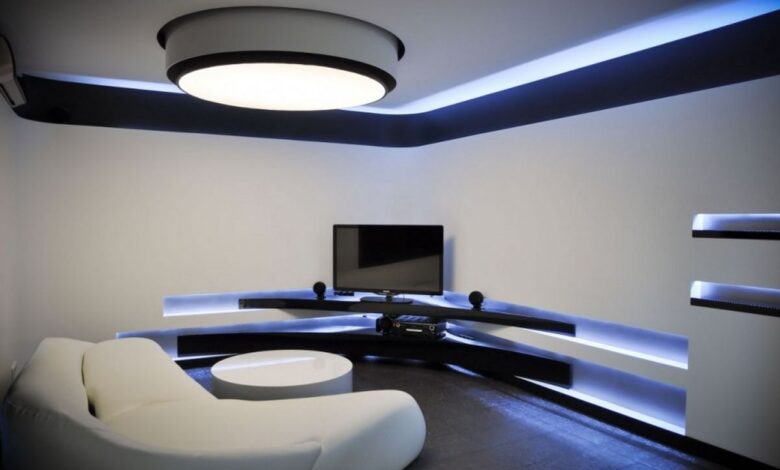
Strip lighting and feature lighting — LED strip (tape) lighting has become popular for under-cabinet kitchen lighting, cove lighting, and architectural feature lighting. Requires appropriate drivers and, for dimmable applications, compatible controllers.
When Do You Need a Licensed Electrician for LED Installation?
This is the question homeowners most often get wrong. Replacing a globe is generally something a homeowner can do safely. However, several scenarios require a licensed electrician:
- Replacing downlight fittings — removing and replacing a fixed luminaire involves working with mains wiring and is prescribed electrical work under WA law.
- Installing new light fittings — any new lighting installation must be carried out by a licensed electrician.
- Replacing or upgrading dimmer switches — replacing a switch involves mains wiring and is licensed work.
- Installing smart switches or smart lighting systems requiring wiring changes — licensed work.
- Any work inside the ceiling space — even seemingly simple re-wiring in a ceiling space constitutes licensed electrical work in WA.
A professional residential LED lighting installation by a licensed electrician ensures the work is done safely, that the fittings are correctly installed and earthed, and that you have the compliance documentation that protects you in the event of an insurance claim.
Planning Your Home LED Upgrade
Before purchasing fittings or calling an electrician, it’s worth thinking through the upgrade room by room:
Living areas — warm white (2700–3000K), dimmable where you have or plan to install a dimmer. Consider accent lighting for shelving, artwork, or architectural features.
Kitchen — 4000K cool white works well for task areas. Under-cabinet LED strip lighting is a popular addition that dramatically improves bench illumination for food preparation.
Bedrooms — warm white, dimmable where possible. Bedside reading light integration worth considering in master bedrooms.
Bathrooms — 3000–4000K, IP-rated fittings in wet zones (shower areas require IP44 or higher rated fittings). CRI 90+ makes a noticeable difference for grooming tasks.
Outdoors — weather-resistant fittings (IP65+ for exposed locations) with motion sensor capability for security and energy efficiency.
Halogen Transformer Compatibility
One technical consideration specific to Perth homes with existing halogen downlights: many installations use a 12-volt MR16 globe powered by an in-ceiling transformer (electronic or magnetic). When replacing the globe with a 12V LED MR16, the existing transformer may be incompatible with the LED driver.
Electronic transformers in particular often have a minimum load requirement that a low-wattage LED globe doesn’t meet, causing flickering, random switching off, or transformer failure. The solution is either to replace the transformer with an LED-compatible driver, or to replace the entire fitting with an integrated LED downlight that operates directly on 240V — typically the cleaner and more future-proof option.
Conclusion: Start With the High-Use Areas and Work Outward
A whole-home LED upgrade doesn’t need to happen in a single project. For homeowners working within a budget, the most effective approach is to prioritise high-use areas — living rooms, kitchens, and main bedrooms — where lights are on for long periods daily. The energy savings from these spaces fund the gradual upgrade of lower-use areas.
Whatever your approach, engaging a licensed electrician for the fitting replacement and wiring work protects you legally and ensures the installation quality that gives LED’s long service life the chance to deliver its full economic benefit. The combination of the right fittings, correctly installed and matched to appropriate dimming control, is what transforms a LED upgrade from a basic energy exercise into a genuinely improved home environment.


